Cheap Van, Big Bill: The Enfield Homeowner's Checklist for Vetting a Rubbish Remover

Photo: waste carrier van and paperwork in London, licensed rubbish removal UK, Environment Agency waste register, via cdn.britannica.com
The cheapest quote for rubbish removal is rarely the cheapest outcome. In Enfield, the difference between a licensed clearance team and a rogue van is often about £30 on the day and several thousand pounds in consequences later. That is not a scare tactic. It is the direct result of householder duty of care rules, and it catches out perfectly sensible people every week.
This is an opinionated checklist. We think it should be standard practice before anyone hands over a mattress, a fridge or a garage full of clutter. If a remover cannot pass these checks, do not let them take your waste.
Why the £5,000 figure keeps coming up
Under household waste duty of care rules, you are responsible for making sure your rubbish is passed to an authorised person. If you give it to an unlicensed carrier and they dump it in an alley off Hertford Road or a lay-by near the A10, the waste can be traced back to you. Enfield Council can issue a fixed penalty, and serious cases can go to court. For householders, fines can reach £5,000. For businesses, the risk is higher.
The £5,000 figure is not a guarantee that every case ends with that fine. It is the upper end of the risk. The more common outcome is a stressful investigation, a penalty notice and a lot of explaining. Either way, it is far more than the tenner you saved by using a bloke with a Transit and no paperwork.
What a waste carrier licence actually is
In England, anyone who transports waste as part of a business usually needs to be registered as a waste carrier, broker or dealer with the Environment Agency. The registration is often called a waste carrier licence, even though it is really a registration. It has a number, a business name and an expiry date. A legitimate removal company should be able to give you that number without hesitation.
There are different tiers. A lower-tier registration covers certain limited activities, but most clearance firms that take household waste from your driveway should be registered as an upper-tier waste carrier. If someone tells you they are licensed but cannot explain what that means, ask for the registration number and check it yourself.
The two-minute licence check
Ask for the waste carrier registration number before you accept a quote. Do not accept a screenshot of a certificate as the only proof. Go to the Environment Agency public register and search the number or business name. Check that the name matches the person or company quoting you. Check the expiry date. Check that the vehicle and the business address look consistent with what you have been told.
If the name on the register is different from the name on the quote, ask why. It might be a trading name, but it might also be a borrowed licence. If the registration has expired, walk away. If they say they do not need one because they are just a man with a van, walk away faster.
Paperwork you should expect
A proper clearance team should provide a written quote or booking confirmation with the business name, address and contact details. They should give you a waste transfer note or a receipt that describes the waste and confirms where it is going. Keep that paperwork for at least two years. If your waste is later found dumped, it is your evidence that you used a licensed carrier.
Ask about insurance, too. A legitimate operator should have public liability insurance and should not mind you asking. If the van has no business name, the driver will not give a surname and the only contact is a mobile number, you are not dealing with a professional clearance service. You are dealing with a risk.
Red flags that should stop you
- Cash only, no receipt and no business address.
- A quote that is dramatically cheaper than everyone else.
- A refusal to provide a waste carrier registration number.
- A promise to take anything, including paint, chemicals or gas bottles, without asking questions.
- An unmarked van with no company details.
- A request to use your bins or leave the waste outside for someone else to collect.
- Pressure to book immediately because they are in the area.
- No written confirmation of the collection date.
One red flag might be explained. Two or three together is a pattern. Do not hand over your waste just because the van is already outside.
Enfield hotspots and why enforcement is getting sharper
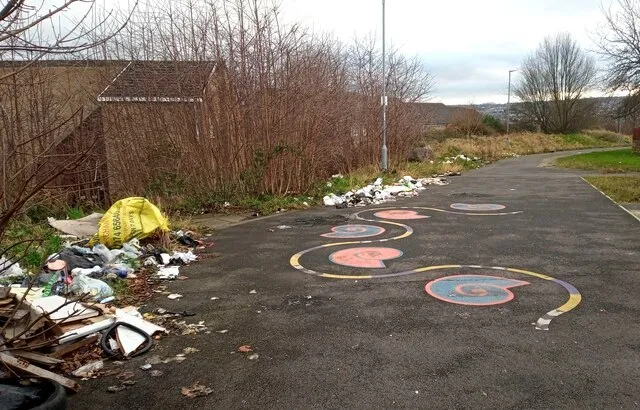
Fly-tipping in Enfield is not random. It clusters around service roads, alleyways and quiet industrial edges where a van can stop without being noticed. Streets around Edmonton Green, the back roads off Hertford Road, the edges of Ponders End and Brimsdown, and some of the lay-bys near the A10 have all had problems. Palmers Green and Southgate get their share of dumped mattresses and building waste too.
Enfield Council uses CCTV, patrols and vehicle evidence to tackle fly-tipping. Number plates, witness reports and paperwork trails all make it easier to trace waste back to the household that produced it. The days of anonymous dumping are not over, but they are getting harder. If your rubbish is found, the first question will be: who took it away?
What to do if you have already used a rogue van
If you suspect your waste has been dumped, report it to Enfield Council and keep every message, quote and bank payment. Take photographs of the waste if it is safe to do so. Do not confront the carrier. Report the matter to the Environment Agency as well. If you have a receipt or a text message, you have a much better chance of showing that you tried to act responsibly.
If you have not yet booked, slow down. A five-minute check is better than a five-month problem.
A simple hiring script
Ask three questions before you book. First: what is your waste carrier registration number? Second: what paperwork will you leave with me? Third: where will my waste be taken? A legitimate company will answer all three without getting defensive. A rogue operator will change the subject, offer a discount or tell you not to worry.
You can also ask for the business address and check it on Companies House if they are a limited company. You can ask for a copy of their insurance. You can ask whether they use a permitted waste site. None of this is unreasonable. It is exactly what a professional clearance firm should expect.
The bottom line
A licensed rubbish removal service costs a little more because it includes proper disposal, paperwork and accountability. A cheap van can look like a bargain because it is externalising the cost onto you and onto the streets of Enfield. The £5,000 risk is real, but the better reason to check is simpler: responsible removal keeps your neighbourhood clear and keeps you out of a mess you never created.
Use the checklist. Ask for the number. Keep the paperwork. If something feels off, trust that feeling and find a licensed team instead.